
Furnace Blower Motor Problems: What to Check First
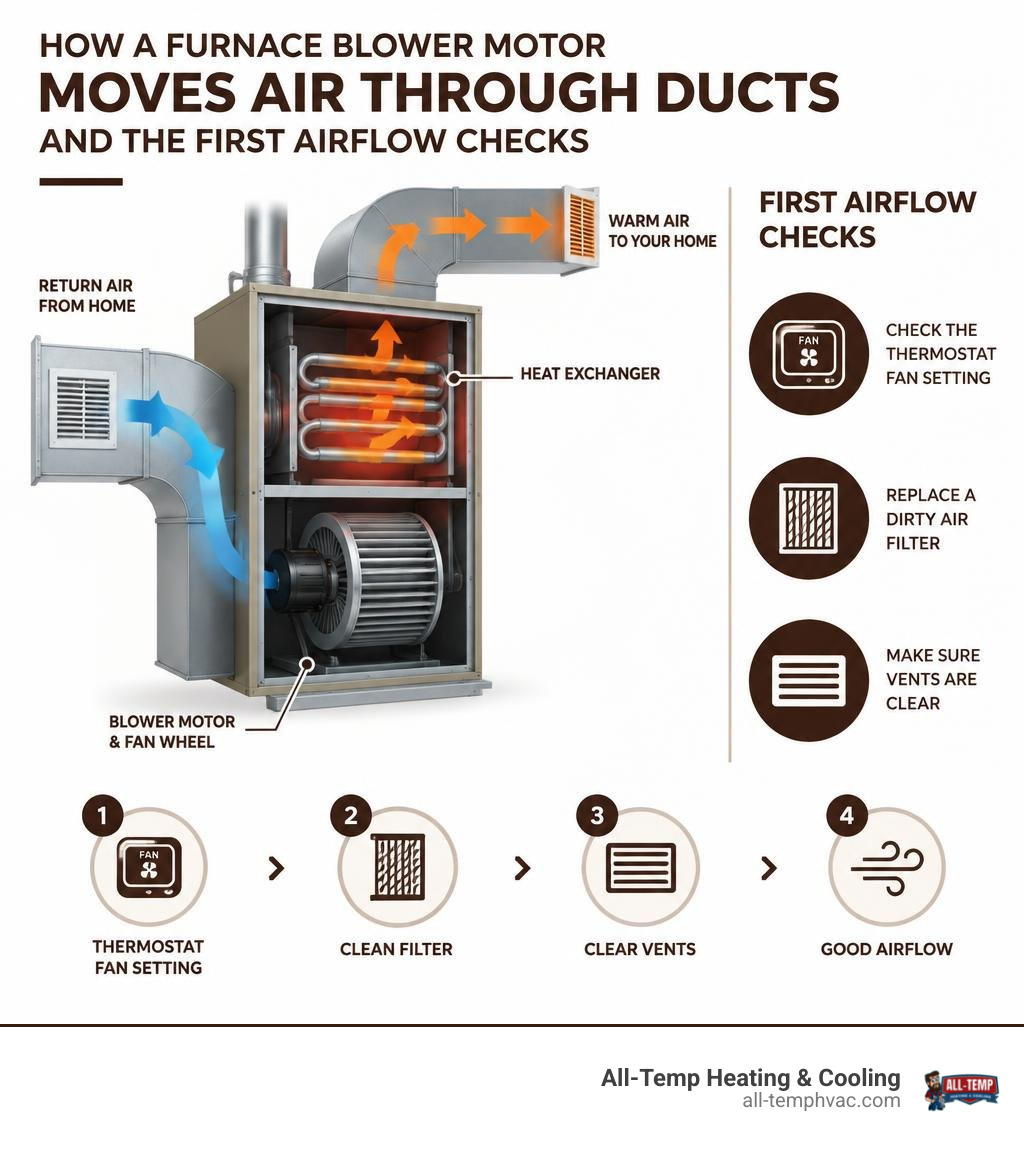
If your Furnace Blower Motor seems to have stopped moving air, check the thermostat fan setting, replace a dirty air filter, and make sure vents are clear. Weak airflow does not always mean the motor has failed. If the blower still will not run, makes a grinding noise, or smells like burning, turn off the furnace and call an HVAC technician.
For more than 15 years, our team at All-Temp Heating & Cooling has served Staunton-area homeowners with heating repairs, including Furnace Blower Motor and airflow problems. Here is how to recognize the warning signs and narrow down the cause.
What Is a Furnace Blower Motor and How Does It Work?
The furnace blower motor serves as the heart of your heating and cooling system. While burners create heat and evaporator coils remove heat, the blower motor forces conditioned air through your supply ducts. Without it, heat remains trapped inside the cabinet, leaving your living spaces cold and risking critical safety shutdowns.
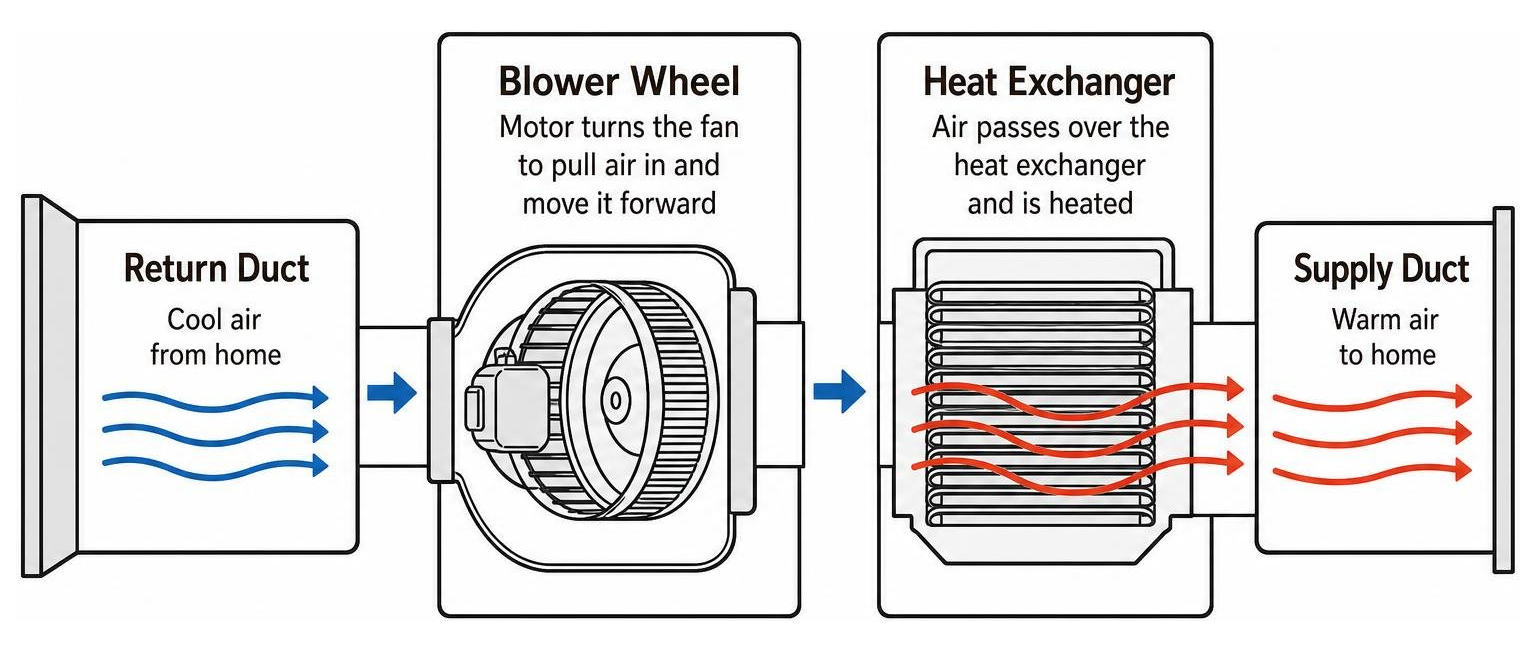
The motor turns a squirrel-cage fan wheel. This cylindrical assembly pulls cool air from the return air plenum through centrifugal force and propels it across the heat exchanger. The air gathers thermal energy and enters the ductwork to warm your home.

Standard residential systems power these direct-drive motors using 115-volt single-phase electricity. When a heating cycle ends, the fan does not stop immediately. Modern control boards run the blower for an extra 1 to 5 minutes to extract remaining heat from the exchanger, maximize energy efficiency, and protect internal components from thermal stress.
Components of the Blower Fan Assembly
Several components work together inside the blower housing:
- Motor Housing and Stator: The outer metal casing protects internal electromagnetic copper windings.
- Direct Drive Shaft: The motor rotor spins a steel shaft clamped to the center hub of the fan wheel.
- Run Capacitor: A small cylindrical component that stores electrical charge to supply continuous torque and keep the motor running smoothly.
- Bearings: Sleeve bearings or sealed ball bearings support the spinning shaft and minimize rotational friction.
- Blower Wheel: A curved metal drum with forward-curved blades that catches and accelerates air.
Single-Speed vs. Multi-Speed Airflow Cycles
Traditional heating systems often rely on single-speed motors that operate at full blast whenever the thermostat calls for heat. Multi-speed and variable-speed systems adjust airflow based on real-time heating demand and static duct pressure.
Using lower speeds creates quieter operation, maintains balanced indoor temperatures, and prevents hot and cold drafts throughout your home. Understanding the causes of uneven home heating helps explain whether blower speed settings or duct design play a role.
Top Warning Signs Your Blower Motor Is Failing
Blower motors rarely fail without warning. Recognizing common furnace repair warning signs helps prevent total system breakdowns and protects the furnace heat exchanger from overheating damage.
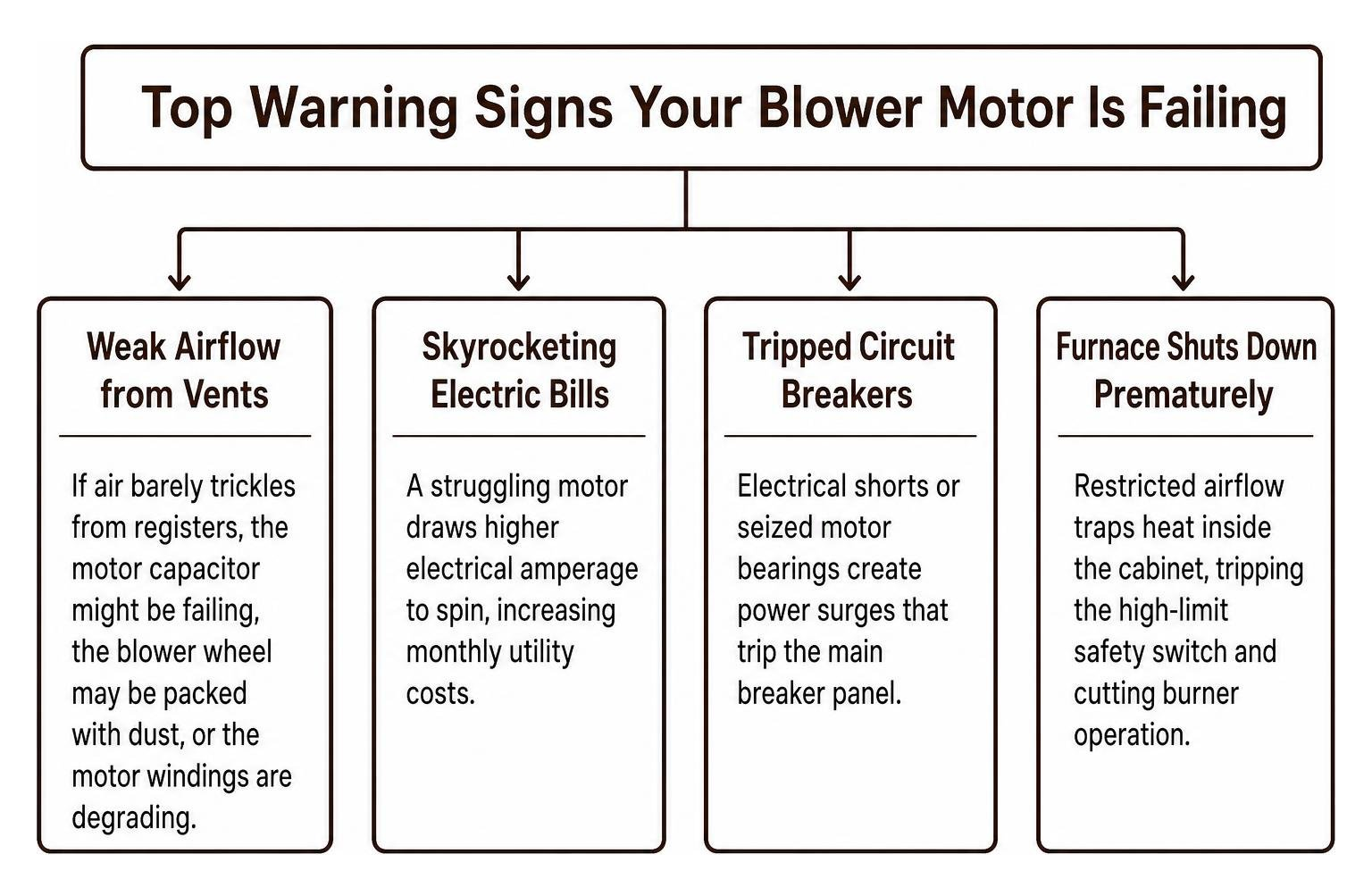
- Weak Airflow from Vents: If air barely trickles from registers, the motor capacitor might be failing, the blower wheel may be packed with dust, or the motor windings are degrading.
- Skyrocketing Electric Bills: A struggling motor draws higher electrical amperage to spin, increasing monthly utility costs.
- Tripped Circuit Breakers: Electrical shorts or seized motor bearings create power surges that trip the main breaker panel.
- Furnace Shuts Down Prematurely: Restricted airflow traps heat inside the cabinet, tripping the high-limit safety switch and cutting burner operation.
Noises, Squealing, and Rattling
Mechanical friction creates distinct noises. High-pitched squealing usually indicates worn sleeve bearings running dry without proper lubrication. Scraping or metal-on-metal sounds suggest the blower wheel has shifted on its shaft and is hitting the metal housing. Rattling sounds point to loose mounting bolts, a failing direct-drive hub, or debris inside the squirrel cage.
Electrical Faults and Overheating Odors
An overheating motor produces a sharp, burning plastic or metallic odor. This smell happens when electrical insulation on the motor windings melts from excessive heat.
When airflow stops entirely and internal components overheat, identifying carbon monoxide risks becomes crucial if the heat exchanger develops cracks.
Step-by-Step Troubleshooting for Blower Fan Issues
Before calling an HVAC technician, complete basic troubleshooting steps to rule out simple external causes.
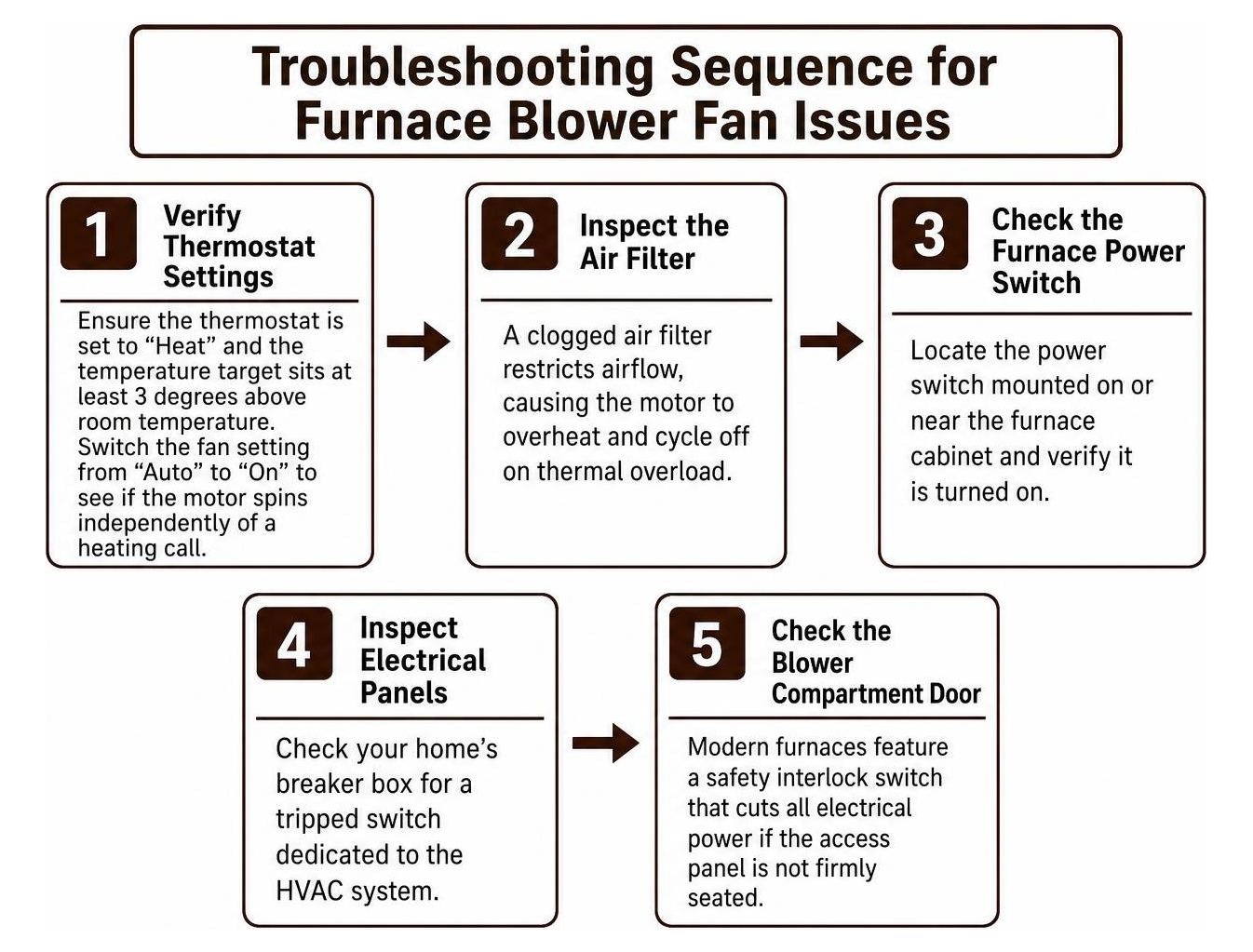
- Verify Thermostat Settings: Ensure the thermostat is set to “Heat” and the temperature target sits at least 3 degrees above room temperature. Switch the fan setting from “Auto” to “On” to see if the motor spins independently of a heating call.
- Inspect the Air Filter: A clogged air filter restricts airflow, causing the motor to overheat and cycle off on thermal overload.
- Check the Furnace Power Switch: Locate the power switch mounted on or near the furnace cabinet and verify it is turned on.
- Inspect Electrical Panels: Check your home’s breaker box for a tripped switch dedicated to the HVAC system.
- Check the Blower Compartment Door: Modern furnaces feature a safety interlock switch that cuts all electrical power if the access panel is not firmly seated.
If these steps do not resolve the issue, our furnace repair service can diagnose the blower motor and related electrical components quickly and safely.
DIY Airflow Checks and Reset Steps
If the system stops running, try replacing the air filter and cycling the power switch off for 60 seconds before turning it back on. These steps allow thermal overload switches to cool and reset. Resolving minor heating issues on a budget is often possible before considering major part replacements.
How to Test a Furnace Blower Motor
Testing electrical components requires precision and proper safety protocols. Professional technicians evaluate motor health using digital multimeters and amp clamps.
Technicians test several vital areas:
- Capacitor Microfarad Rating: Measuring capacitance with a meter verifies whether the run capacitor provides the microfarad output specified on its label. A weak capacitor prevents the motor from starting or running efficiently.
- Winding Resistance: Testing resistance across individual motor speed taps identifies internal electrical shorts or open windings.
- Operating Amp Draw: Clamping a meter around the motor lead while running measures real-time current draw against the rated full load amps on the motor nameplate.
Professional Blower Motor Services
If basic troubleshooting does not restore airflow, our team provides complete heating services across Staunton, Harrisonburg, and surrounding areas. We diagnose blower motor faults, test capacitors, and verify airflow levels to keep your furnace running safely.
Types of Blower Motors: PSC vs. ECM Technology
Residential furnaces use two primary motor designs: Permanent Split Capacitor (PSC) motors and Electronically Commutated Motors (ECM).
PSC motors use alternating current (AC) and rely on a run capacitor to create a rotating magnetic field. They run at fixed speeds, providing simple operation but drawing continuous high wattage.
ECM units use direct current (DC) brushless designs managed by an integrated electronic control module. These motors convert incoming AC power to DC, allowing precise speed adjustments, built-in soft-start technology, and superior electrical efficiency.
| Feature | PSC Motor | Constant Torque ECM (e.g., X13) | Variable-Speed ECM |
|---|---|---|---|
| Electrical Efficiency | 50% to 65% | Up to 80% | 80% to 85%+ |
| Speed Control | Fixed Multi-Speed Taps | Staged Speed Control | Fully Modulating Variable Speeds |
| Operating Sound | Moderate to Loud | Quiet Soft-Start | Whisper-Quiet Operation |
| Surge Protection | External / None | Built-in 4kV to 6kV | Advanced Internal Protection |
| Average Motor Lifespan | 10 to 15 Years | 15 to 20 Years | 15 to 20 Years |
PSC Motors vs. ECM Efficiency
PSC motors consume significant electrical power every time they spin. By comparison, ECM models can operate at up to 80% efficiency, using a fraction of the electricity when running at low, continuous speeds.
Universal replacement blower motors can fit common furnace configurations when a qualified HVAC technician matches the frame size, voltage, horsepower, speed, rotation, and control requirements. Proper motor selection helps protect the furnace’s electrical components and supports reliable airflow.
Upgrading to a Variable-Speed Furnace Blower Motor
Upgrading to a variable-speed motor improves whole-home air circulation. These motors ramp up slowly using soft-start programming, reducing wear on the fan wheel and eliminating the sudden burst of air noise associated with standard motors.
Variable-speed operation helps regulate indoor humidity and maintains steady temperatures across every room. Evaluating modern furnace replacement options and system costs helps you compare long-term energy savings.
Repair vs. Replacement: Costs, Lifespan, and Maintenance
Furnace blower motors typically last 15 to 20 years, matching the average lifespan of a well-maintained furnace. When a motor fails, you must decide whether to replace the motor assembly or invest in a new heating system.
Consider these factors when deciding:
- Age of the Furnace: If your furnace is under 10 years old, replacing the motor makes good financial sense. If the system is approaching 15 to 20 years, investing in a new furnace provides better long-term reliability.
- Component Availability: Remanufactured ECM motors and universal direct-drive models come tested under electrical load and often carry 2-year warranties, offering a reliable middle ground between cheap parts and full system replacements.
- Overall System Health: If the heat exchanger, gas valve, and draft inducer motor show signs of corrosion or wear, replace the complete unit rather than sinking money into single repairs.
Blower Motor Replacement Costs
Blower motor replacement costs depend on several technical specifications:
- Horsepower Rating: Common residential motors range from 1/3 HP, 1/2 HP, to 3/4 HP. Higher horsepower units designed for larger homes require heavier windings and cost more.
- Motor Technology: Standard PSC motors cost less than advanced variable-speed ECM assemblies with computerized control modules.
- Electrical Matching: Matching the correct voltage (115V vs. 208-230V), operating speed (standard 1075 RPM), and rotation direction ensures proper performance without damaging new parts.
- Labor and Diagnostics: Professional installation covers electrical testing, capacitor replacement, blower wheel balancing, and airflow static pressure verification. Understanding regional HVAC repair in Harrisonburg, VA helps homeowners plan for local service and diagnostic standards.
Our furnace maintenance service provides furnace maintenance to keep your blower motor operating efficiently and catch problems before they cause a breakdown.
Preventive Maintenance to Extend Motor Lifespan
Routine preventive care protects your motor from premature mechanical wear and electrical strain. Understanding what a furnace tune-up includes highlights the importance of routine maintenance.
Follow these essential maintenance practices:
- Change Air Filters Regularly: Check 1-inch filters every 30 to 60 days. A clean filter prevents dust from insulating motor windings and ensures sufficient cooling airflow across the motor casing.
- Clean the Blower Wheel: Dirt accumulating on curved fan blades reduces CFM airflow capacity and unbalances the wheel, causing shaft vibration and bearing failure.
- Inspect the Run Capacitor: Test capacitor microfarad ratings annually to replace weak capacitors before they stress the motor start windings.
- Lubricate Motor Ports: If your motor has oil ports, apply a few drops of non-detergent motor oil during annual maintenance visits. Most modern motors feature permanently sealed ball bearings that do not require oiling.
Frequently Asked Questions About Blower Fans and Airflow
How long does a furnace blower motor typically last?
A quality blower motor typically lasts 15 to 20 years. Maintaining clean air filters, keeping return air grilles unblocked, and scheduling annual tune-ups protect the motor bearings and electrical windings, allowing the component to last the full lifespan of your furnace.
Why does my furnace fan run after the heat turns off?
The blower fan normally runs for 1 to 5 minutes after the burners shut off. This delay cycle dissipates residual heat from the heat exchanger, pushes the remaining warm air into your living spaces, and safely cools the combustion chamber to prevent limit switches from tripping.
Can I replace a furnace blower motor myself?
Replacing a blower motor requires handling high-voltage wiring, discharging capacitors that store dangerous electrical charges, and balancing the fan wheel on the motor shaft. Installing the wrong horsepower, voltage, rotation direction, or capacitor can damage your control board or create a fire hazard. We recommend hiring a certified HVAC technician to handle the replacement safely.
Restoring Reliable Heat and Airflow to Your Home
When your furnace blower stops circulating warm air, fast and dependable repair service keeps your home comfortable and safe. All-Temp Heating & Cooling delivers complete heating and AC solutions throughout Staunton, Harrisonburg, Waynesboro, Stuarts Draft, Bridgewater, Elkton, Charlottesville, Fishersville, Greenville, Grottoes, Verona, and Wintergreen, Virginia.
Our certified technicians carry diagnostic equipment and replacement parts to solve airflow problems on the spot. We back our craftsmanship with a two-year labor warranty, honest recommendations, and modern diagnostic technology.
If you smell burning odors or hear strange noises from your heating cabinet, shut off power at the switch. Then contact our furnace repair specialists to schedule an inspection and restore even heating throughout your home.