

Why Getting the Right AC Size Is One of the Most Important Home Decisions You’ll Make
Knowing how to choose the right AC size can be the difference between a cool, comfortable home and one that feels sticky, uneven, or expensive to run. And yet, it’s one of the most commonly misunderstood parts of buying a new system.
Here’s a quick answer to get you started:
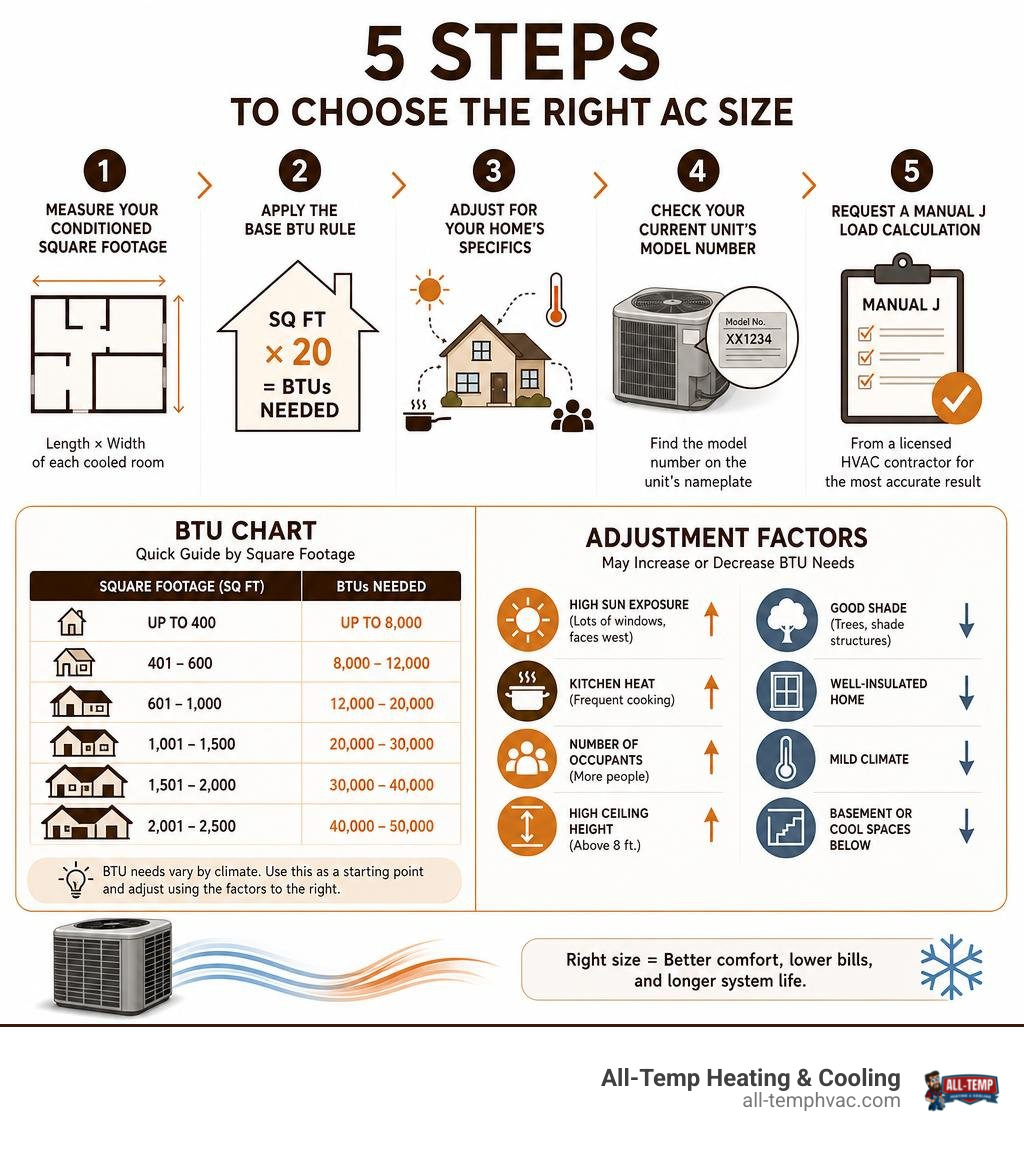
- Measure your conditioned square footage (length x width of each cooled room).
- Apply the base BTU rule (multiply square footage by 20 to get BTUs needed).
- Adjust for your home’s specifics (ceiling height, sun exposure, kitchen heat, and number of occupants).
- Check your current unit’s model number to confirm existing tonnage.
- Request a Manual J load calculation from a licensed HVAC contractor for the most accurate result.
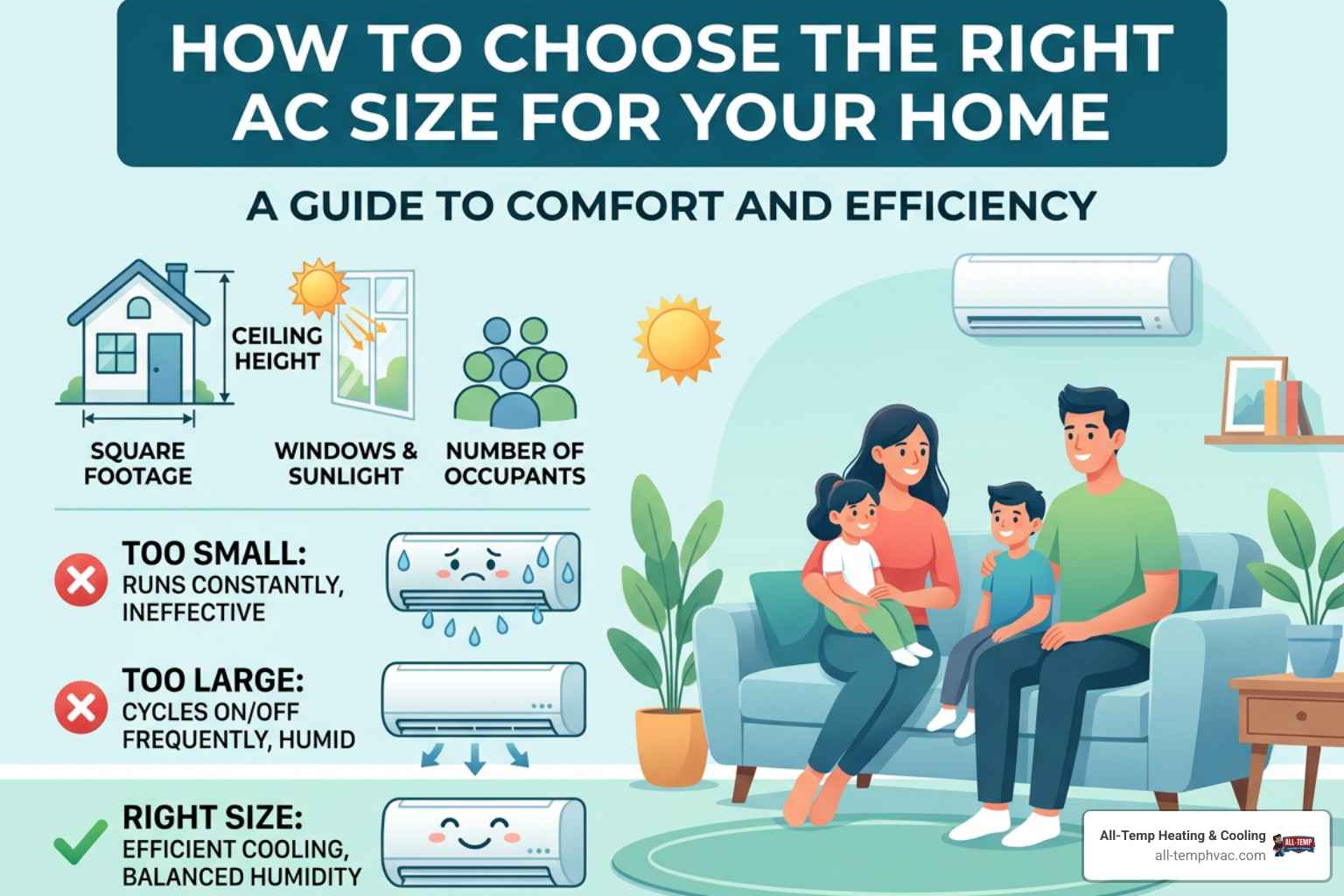
Most people assume bigger means better. It doesn’t. An oversized AC cools the air too fast, then shuts off before it removes enough humidity. The result? A home that feels cold and clammy, with energy bills that keep climbing.
On the flip side, an undersized unit runs constantly, struggles to hit your set temperature, and wears out faster.
The goal is to get it just right.
That’s exactly what this guide walks you through, step by step.
At All-Temp Heating & Cooling, our team has helped homeowners across Staunton, Harrisonburg, Waynesboro, Charlottesville, Stuarts Draft, Fishersville, and the Shenandoah Valley learn how to choose the right AC size before making one of the biggest investments in their home’s comfort. We’ll share the same straightforward process our team uses every day, so you can walk into any sizing conversation with confidence.
Why Learning How to Choose the Right AC Size Matters
Sizing an air conditioner is not like buying a television or a refrigerator. You cannot simply pick a larger model because you want extra power. In the HVAC industry, we measure cooling capacity in two main terms: British Thermal Units (BTUs) and tonnage.
A BTU measures the amount of heat energy an air conditioner can remove from your home in one hour. Specifically, one BTU is the energy required to raise or lower the temperature of one pound of water by one degree Fahrenheit. Tonnage is simply a larger unit of measurement. One ton of cooling capacity equals exactly 12,000 BTUs per hour. This historical term comes from the amount of heat required to melt one ton of ice over a 24-hour period.
If you install a system with too much capacity, you will run into severe oversized HVAC equipment issues. An oversized system suffers from a phenomenon called short cycling. Because the unit is too powerful, it rapidly cools the indoor air down to your thermostat’s setpoint and shuts off.
This rapid cycling is a major problem for two reasons. First, the air conditioner does not run long enough to dehumidify your home. Air conditioners remove moisture from the air as they run. A system needs to run continuously for at least 15 to 20 minutes to start effectively pulling humidity out of the air. Short cycling leaves you with cold, clammy air, which encourages mold growth and ruins your indoor air quality. Second, starting and stopping the compressor frequently consumes massive amounts of electricity and accelerates wear and tear. In fact, an oversized AC unit can increase your energy consumption by 15% to 25% due to these frequent starts.
Alternatively, an undersized unit brings its own set of headaches. It will run constantly without ever reaching your desired temperature on hot Virginia summer days. This continuous operation drives up your utility bills and causes the system to burn out years ahead of its time. When homeowners need a professional sizing review before replacing equipment, All-Temp Heating & Cooling can evaluate the home’s cooling load as part of our HVAC services so the recommendation fits the space instead of relying on guesswork.
The 5-Step Guide to Sizing Your Air Conditioner
Finding the perfect cooling capacity requires a systematic approach. We start with a baseline estimation based on your home’s physical footprint, apply standard rules of thumb, make environmental adjustments, verify your existing system, and finish with a professional load match. Follow these five steps to find your ideal fit.
Step 1: Calculate Square Footage to Learn How to Choose the Right AC Size
Your sizing journey starts with measuring the actual conditioned living space of your home. Do not just look at your local property tax assessment, as that often includes unconditioned spaces like unfinished basements, garages, or attics. You only want to calculate the square footage of the rooms that your new air conditioner will actively cool.
To find the square footage of a standard rectangular room, simply use a tape measure to find the length and width of the space, then multiply those two numbers together:
- Square Footage = Length x Width
If you have an open floor plan or L-shaped rooms, divide the space into smaller rectangles, calculate the square footage of each section, and add them together. For triangular areas, multiply the base by the height and divide by two.
Once you have measured every room that will receive cool air, sum the totals to find your overall conditioned square footage. If you are planning a larger replacement project, the same measurements help your contractor compare your estimate with the existing system and the home’s actual comfort needs.
Step 2: Apply the Standard BTU Rule of Thumb
Now that you have your total square footage, you can apply the industry standard rule of thumb. In moderate climates, we generally recommend 20 BTUs of cooling capacity per square foot of living space.
To calculate your base cooling capacity, multiply your conditioned square footage by 20:
- Base BTU Requirement = Square Footage x 20
For example, if you are sizing a system for a 1,500 square foot home, your base calculation would look like this:
- 1,500 sq. ft. x 20 BTUs = 30,000 BTUs
To convert this number into tonnage, divide the total BTUs by 12,000:
- 30,000 BTUs / 12,000 = 2.5 Tons
To help you visualize these estimates, we have compiled a quick reference table showing standard residential cooling capacities based on square footage:
| Square Footage | Required Cooling Capacity (BTUs) | Standard Tonnage |
|---|---|---|
| 600 to 900 | 18,000 BTUs | 1.5 Tons |
| 1,000 to 1,200 | 24,000 BTUs | 2.0 Tons |
| 1,200 to 1,500 | 30,000 BTUs | 2.5 Tons |
| 1,500 to 1,800 | 36,000 BTUs | 3.0 Tons |
| 1,800 to 2,100 | 42,000 BTUs | 3.5 Tons |
| 2,101 to 2,400 | 48,000 BTUs | 4.0 Tons |
| 2,401 to 3,000+ | 60,000 BTUs | 5.0 Tons |
While this table provides an excellent starting point, square footage is only part of the equation. Local architectural features and environmental factors can shift your required capacity by up to a full ton.
Step 3: Adjust for Ceilings, Sun, and Kitchens
No two homes are identical. A 2,000 square foot ranch house with standard eight-foot ceilings and heavy shade requires much less cooling than a 2,000 square foot contemporary home with vaulted ceilings and massive west-facing windows. You must adjust your base BTU calculation to account for these unique variables:
- Ceiling Height: The standard 20 BTU rule assumes an eight-foot ceiling. If your home has nine-foot or vaulted ceilings, you have more air volume to cool. Add 10% to your base BTU requirement for every foot of ceiling height above eight feet.
- Sun Exposure: If your home sits on a heavily shaded lot under mature trees, reduce your BTU capacity by 10%. If your home receives full, intense sun exposure throughout the day, increase your capacity by 10%.
- Occupancy Heat Load: The human body naturally radiates heat; each average adult contributes roughly 400 to 600 BTUs of heat per hour to a space. The standard sizing rules assume two primary occupants. If you regularly have more than two people living in a home or using a specific room, add 600 BTUs for each additional person.
- Kitchen Appliances: Kitchens generate incredible amounts of heat from ovens, ranges, refrigerators, and dishwashers. If you are sizing a system that includes an open kitchen, add 4,000 BTUs to your total capacity requirement.
By making these custom adjustments, you will get a much more realistic picture of your home’s actual thermal load. If those adjustments reveal that your old system may have been poorly matched, our AC replacement sizing guide explains how replacement planning should account for comfort issues, equipment age, and the way your home has changed over time.
Step 4: Read Your Current Unit Model Number
Another highly effective way to verify your sizing estimate is to look at the capacity of your existing air conditioner. Manufacturers do not print the tonnage directly on the yellow EnergyGuide label or the metal nameplate. Instead, they hide the capacity inside the model number on the outdoor condenser unit.
Go outside and locate the data plate on your outdoor unit. Look for a long string of letters and numbers labeled “Model Number” or “M/N.” Within this model number, look for a prominent two-digit even number. This number represents the capacity of the unit in thousands of BTUs.
Because residential central air conditioners are manufactured in half-ton increments, you will want to look for the following specific numbers:
- 18 = 18,000 BTUs (1.5 Tons)
- 24 = 24,000 BTUs (2.0 Tons)
- 30 = 30,000 BTUs (2.5 Tons)
- 36 = 36,000 BTUs (3.0 Tons)
- 42 = 42,000 BTUs (3.5 Tons)
- 48 = 48,000 BTUs (4.0 Tons)
- 60 = 60,000 BTUs (5.0 Tons)
For example, if you see a model number like GSX140241K, the “24” tells you that you currently have a 2-ton (24,000 BTU) system. Comparing this number to your calculated estimate will help you determine if your previous system was sized correctly.
Step 5: Request a Manual J Calculation to Know How to Choose the Right AC Size
While rules of thumb and model-number decoding are fantastic for ballpark estimates, you should never purchase a new HVAC system based on these shortcuts alone. The gold standard of the HVAC industry is the Manual J load calculation. Developed by the Air Conditioning Contractors of America (ACCA), this mathematical protocol calculates the exact thermal behavior of your home.
A professional Manual J load calculation does not just look at square footage. It accounts for a wide range of critical variables:
- The exact R-value of your wall, floor, and attic insulation.
- The solar heat gain coefficient and U-values of your windows.
- The geographical orientation of your home (which walls face south and west).
- Local climate design temperatures for our specific Virginia region.
- The structural airtightness of your home and air infiltration rates.
- The heat generated by lighting, electronics, and appliances.
- The layout, insulation, and leakage rates of your existing ductwork.
Skipping this step is a massive risk. If a contractor walks through your home and gives you a quote based purely on square footage or simply matches your old system without running a Manual J calculation, treat it as a major red flag.
Your insulation may have settled, or you might have upgraded to high-efficiency double-pane windows since your last AC installation. These home improvements reduce your cooling load, meaning you might actually need a smaller, less expensive system than before. For homeowners replacing older equipment, our team can connect sizing, ductwork, and efficiency decisions through professional HVAC services so the final recommendation supports long-term comfort.
Before the FAQ section, it is also worth thinking about installation quality itself. Even a properly sized system can underperform if the ductwork, airflow, refrigerant charge, or setup process is rushed, which is why our AC installation service overview walks through what homeowners should expect from a careful installation from start to finish.
How SEER2 Ratings Impact Your Sizing Decisions
As you explore different air conditioning models, you will also need to consider their energy efficiency. In our industry, we measure this efficiency using the Seasonal Energy Efficiency Ratio 2 (SEER2) rating.
SEER2 measures the total cooling output of an air conditioner over a typical cooling season divided by the total electric energy input it consumes. The higher the SEER2 number, the less electricity the system uses to cool your home. Most modern residential central air systems have ratings ranging from 13.4, the regional minimum standard, up to 22+ SEER2 for premium, high-efficiency equipment.
It is vital to understand that a SEER2 rating does not change the required capacity of your system. A 3-ton unit rated at 14 SEER2 removes the exact same amount of heat, 36,000 BTUs per hour, as a 3-ton unit rated at 20 SEER2. However, the 20 SEER2 system will use significantly less electricity to get the job done.
When you choose a high-efficiency system, you can often offset the higher upfront equipment cost through lower monthly utility bills, federal tax credits, or utility rebates. To see how these efficiency decisions translate to real-world savings, our AC replacement energy savings article explains why the right replacement system can lower operating costs without oversizing the equipment.
Frequently Asked Questions About AC Sizing
We hear many of the same questions from homeowners in Augusta and Rockingham counties when they begin shopping for a new air conditioner. Here are straightforward answers to the most common concerns.
What are the signs that my current AC is the wrong size?
If your air conditioner is the wrong size, your home will drop several hints:
- Short Cycling: If your system turns on, runs for five minutes, shuts off, and repeats this cycle multiple times an hour, it is likely oversized.
- High Humidity: If the indoor air feels sticky, damp, or clammy even though the thermostat says 72 degrees, your system is too large to properly dehumidify.
- Uneven Temperatures: If your upstairs rooms are sweltering while your downstairs rooms are freezing, your system may be improperly sized or struggling with poor ductwork design.
- Constant Operation: If your AC runs continuously all day and night without ever reaching your target temperature, it is undersized.
- Skyrocketing Energy Bills: Both oversized and undersized units run inefficiently, leading to unusually high electric bills.
Why is an oversized AC unit worse than an undersized one?
Homeowners often assume that having extra capacity is a safe bet, but an oversized system is actually much more problematic than a slightly undersized one.
Because an oversized system short-cycles, it subjects its compressor to constant, abrupt starts. This causes rapid mechanical wear and tear, often cutting the expected lifespan of a system down from 15 to 20 years to just 8 to 12 years.
Furthermore, the lack of proper humidity control creates a breeding ground for mold, mildew, and dust mites. This can trigger allergies and ruin your indoor air quality. Finally, starting a compressor requires a massive surge of electrical current; frequent short cycles will cause your energy bills to climb much higher than if you had a properly sized unit running longer, smoother cycles.
How many square feet does a 3-ton AC unit cool?
A 3-ton air conditioner provides 36,000 BTUs of cooling capacity. In a standard home with average insulation and typical window placement, a 3-ton system will comfortably cool between 1,500 and 1,800 square feet.
However, this range can change based on local factors. If your home has excellent modern insulation, high-efficiency windows, and plenty of shade, a 3-ton unit might easily cool up to 2,000 square feet. Conversely, if you live in an older home with drafty windows, poor insulation, and vaulted ceilings, that same 3-ton unit might only cover 1,200 square feet. This is why a professional load calculation is so essential.
Professional AC Sizing and Installation in Staunton, VA
At All-Temp Heating & Cooling, we believe that home comfort is a science. We do not rely on guesses or quick shortcuts. When you trust us with your home comfort, our certified technicians perform a comprehensive, professional load calculation to ensure your new system is sized perfectly for your home’s unique layout.
We proudly serve homeowners and small businesses throughout Staunton, Harrisonburg, Waynesboro, Charlottesville, Stuarts Draft, Fishersville, Bridgewater, Elkton, Augusta County, Albemarle County, and surrounding communities. We back our work with an industry-leading two-year labor warranty, honest service, and the latest diagnostic technology.
If you suspect your current system is the wrong size, or if you are ready to upgrade to a high-efficiency AC system that will keep your home comfortable and your energy bills low, we are here to help. Contact our professional AC technicians today to get started.