

Why Air Registers and Duct Boots Leak
Duct sealing fixes vent leaks when you can see gaps around the register boot, feel weak airflow at the grille, or notice hot and cold spots near the vent. Sealing the boot to the drywall and the duct collar restores proper airflow and stops conditioned air from escaping into wall and ceiling cavities.
Air registers and duct boots sit at the boundary between your living space and unconditioned framing cavities. The metal boot connects the main duct run directly to your room register. Over time, physical movement, house settling, and normal heating cycles cause these connections to separate.
Sheet metal expands when heated and contracts when cooled. This continuous movement loosens the mechanical fasteners holding boots to wall studs or ceiling joists. As gaps open around the drywall, conditioned air escapes into wall voids instead of entering your living area.
Standard duct tape dries out, cracks, and falls off within a few seasons. Flexible duct connections wrapped with non-rated adhesives also sag under their own weight. Whenever you notice hot or cold spots near your grilles, you likely need air duct leak repair to secure loose fittings and restore proper airflow.
Return Leaks vs Supply Leaks
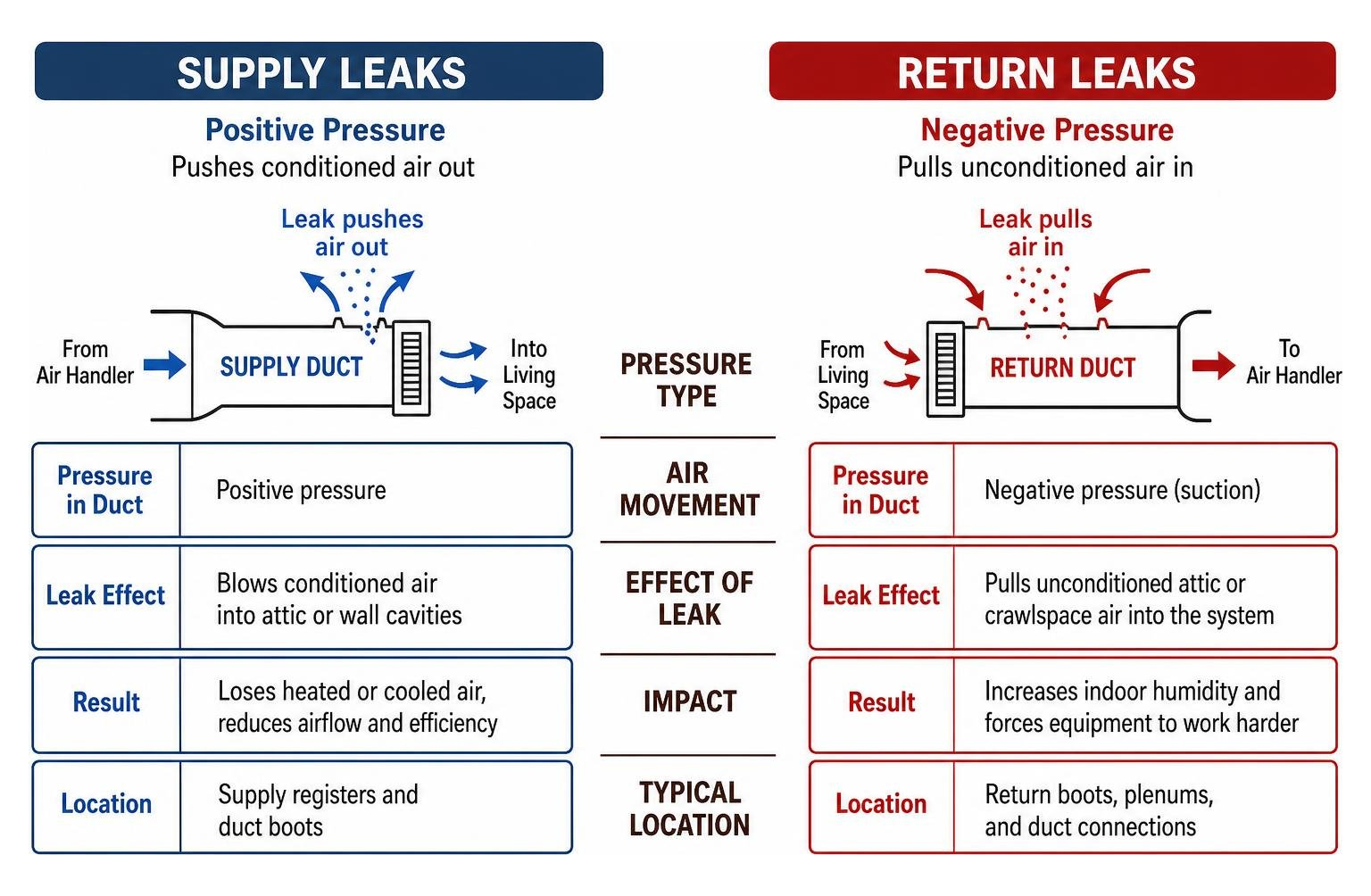
Duct systems have two distinct pressure zones: supply and return. Supply ducts push conditioned air into your rooms under positive pressure. Return ducts pull air back to the air handler under negative pressure. Both types of leaks waste energy, but they create different problems in your home.
Return leaks make up roughly 26% of total duct leakage in average residential systems. Field data shows that weighted average return leakage accounts for 115 CFM at standard operating pressures. Because return ducts operate under suction, holes pull unconditioned attic or crawlspace air directly into the system. This increases indoor humidity and forces equipment to work harder. Supply leaks, meanwhile, blow heated or cooled air directly outside your living envelope, reducing system airflow and wasting conditioned air.
Why Attic Installations Require Duct Sealing for Vent Leaks
Attic-mounted ductwork faces harsh temperature swings. During Virginia summers, attic temperatures often rise above 120 degrees Fahrenheit. When return boots or plenums develop leaks in these spaces, they pull superheated air straight into the cooling coil.
A 15% return leak from a 120-degree attic reduces the effective capacity and Energy Efficiency Ratio (EER) of your cooling system by up to 50%. A 30% return leak can create a cooling load that exceeds the design capacity of an otherwise properly sized AC system. Following duct sealing specifications and best practices ensures that high-temperature attic leaks are fully sealed to protect your cooling performance.
The Energy, Financial, and Health Costs of Leaky Vents
Leaky ductwork causes significant energy waste across the country. Typical duct installations lose 25% to 40% of the heating or cooling energy produced by a heat pump, furnace, or air conditioner.
Average residential duct systems show a total leakage rate of 348 CFM at 25 Pascals of test pressure. This unnecessary air loss adds an average of $280 per year to heating and cooling bills for a single home. Understanding the primary benefits of sealing air ducts helps homeowners lower their utility bills, balance room temperatures, and reduce unnecessary wear on their HVAC equipment.
Measuring Airflow Loss and the GSCA Protocol
HVAC professionals measure leakage using calibrated blower doors and duct pressurization gauges. Technicians depressurize or pressurize the duct network to a standard reference pressure of 25 Pascals (Pa) to calculate total cubic feet per minute (CFM) of leakage.
Modern diagnostic testing relies on the Generalized Subtraction Correction Algorithm (GSCA). The GSCA protocol isolates supply leaks from return leaks while accounting for operating pressure differences. This approach gives technicians an accurate assessment of system tight spots compared to older subtraction methods. Measuring air leakage accurately ensures our team targets the specific joints and boots that cause the greatest thermal loss.
Indoor Air Quality and Safety Hazards
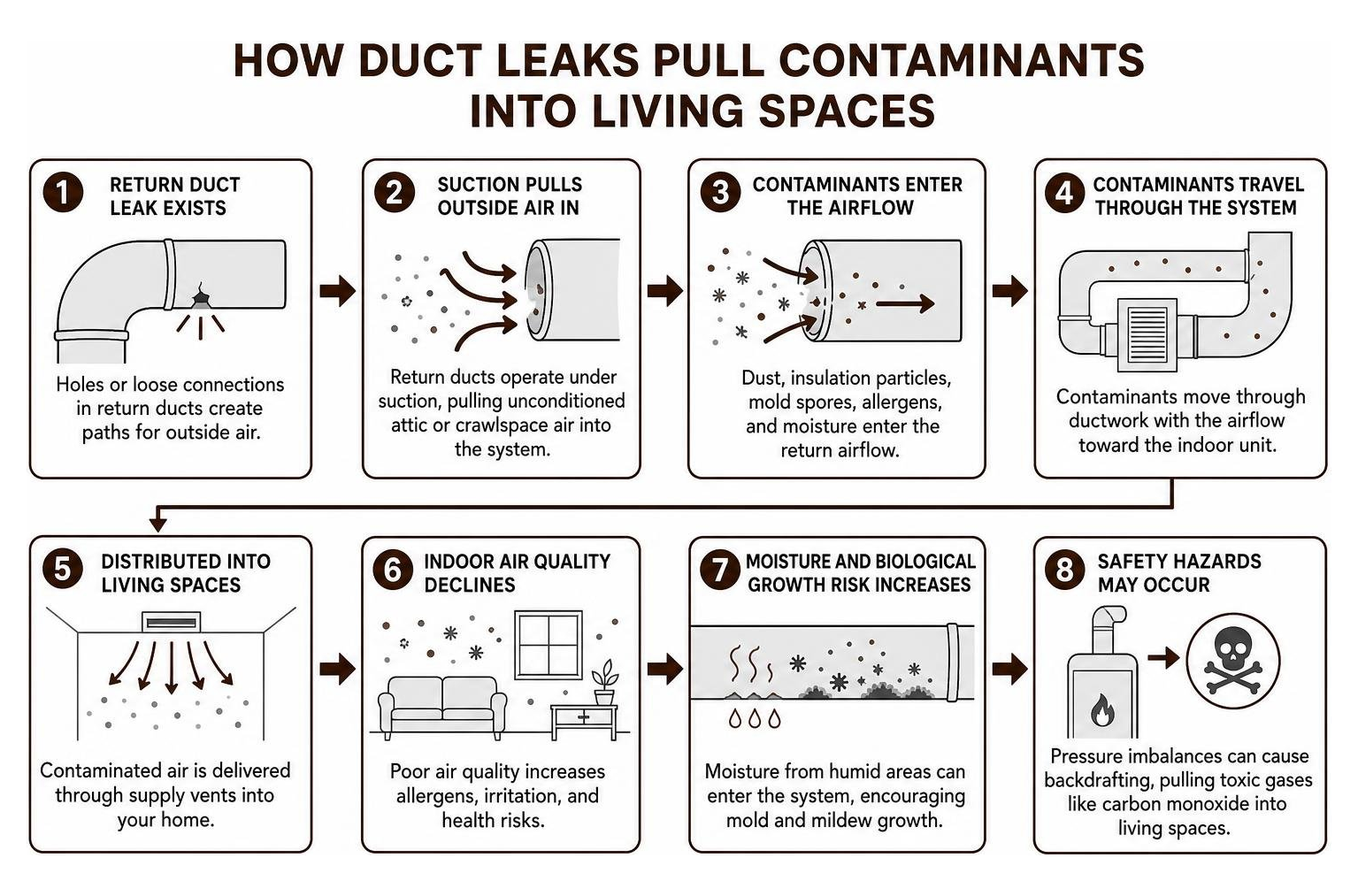
Leaky duct boots create major indoor air quality issues. Return-side suction pulls attic insulation particles, fiberglass dust, mold spores, and outdoor allergens directly into your breathing air. Moisture from humid crawlspaces can enter the return air stream, encouraging biological growth inside the distribution system.
Duct leaks also cause pressure imbalances that compromise combustion safety. When supply leaks blow air outside the conditioned living space, the home experiences negative pressure. This negative pressure can cause water heaters and furnaces to backdraft, pulling toxic flue gases and carbon monoxide back down the chimney and into your living rooms.
Step-by-Step Duct Sealing for Vent Leaks

Sealing vent leaks requires attention to detail, proper surface preparation, and certified sealing compounds. Durable sealing keeps air inside your distribution system and prevents unconditioned air from infiltrating your living areas. If your home has aging or poorly installed ductwork, systematic boot and joint sealing stops air loss and restores balanced delivery across all rooms.
Preparing Register Boots and Joint Surfaces
Start by turning off power to your HVAC equipment at the thermostat and breaker panel. Remove the register grilles using a screwdriver to expose the metal boot and the surrounding drywall cutout.
Thoroughly vacuum dust, drywall shavings, and loose debris from the inside of the boot and surrounding framing. Wipe down the metal surfaces with a clean rag to remove oil and grime. If the duct interior contains heavy debris or biological growth, scheduling professional duct cleaning clears the lines before you seal the joints. Fasten the metal boot firmly to the surrounding framing using heavy-duty sheet metal screws to eliminate mechanical movement.
Applying Mastic and Reinforcing Mesh to Vent Joints
Apply a thick, uniform coat of water-based elastomeric mastic over the metal seams and the boot-to-drywall boundary. Use a firm paintbrush or chop brush to spread the mastic across all gaps.
For joints or gaps wider than 1/4 inch, embed fiberglass mesh tape into the wet base coat of mastic. Lay down a continuous second layer over the mesh to build a durable 20 to 40 wet mil thickness (roughly 1/8 inch thick). High-grade duct sealants remain flexible after curing, maintaining an airtight barrier even as ducts expand and contract through seasonal temperature shifts.
Post-Sealing Verification and Pressure Testing
Allow the mastic to cure for 24 to 48 hours before running the system at high static pressure. Once the sealant dries, run a post-sealing pressure test to verify performance.
Sealing projects should target at least a 50% reduction in duct leakage. A diagnostic gauge confirms that air leakage rates have dropped to safe, efficient levels. Technicians then check airflow velocity at each room register using an anemometer and conduct a combustion draft test on all fuel-burning appliances to confirm that indoor pressure remains safe.
Sealant Technologies and Material Selection
Choosing the right sealing materials ensures long-lasting repairs. Traditional rubber-backed or cloth-backed duct tapes degrade rapidly under attic heat and must never be used on HVAC systems. Water-based elastomeric mastics, UL-listed foil tapes, and aerosol sealants offer the durability needed to keep ducts sealed over time.
| Sealing Method | Best Application | Durability Rating | Pressure Rating | Key Advantage |
|---|---|---|---|---|
| Elastomeric Mastic | Boots, plenums, accessible fittings | High (15+ years) | Up to 16 in. w.g. | Fills wide gaps; stays flexible |
| UL 181 Foil Tape | Smooth metal seams, flat rigid duct board | Moderate to High | Up to 10 in. w.g. | Clean application; instant bond |
| Aerosol Polymer | Hidden runs, inaccessible wall chases | High (15+ years) | Standard residential | Seals from inside without drywall removal |
Selecting Certified Mastics for Duct Sealing for Vent Leaks
Always check sealant containers for UL 181A-M (for rigid duct board) or UL 181B-M (for flexible duct systems) labels. Certified mastics meet strict flame spread and smoke development ratings under ASTM E84 testing.
Premium mastics also feature low VOC levels (under 50 g/L) and GREENGUARD Gold certifications to protect indoor air quality during and after installation. Formulations found in the Energy Seal Coatings technical data include mold inhibitors that stop fungal growth inside dark, enclosed duct runs.
Aerosol Sealing for Inaccessible Vent Runs
Many duct runs travel through finished drywall ceilings, floor joists, and narrow wall chases where hands and brushes cannot reach. For these hidden sections, aerosolized sealing provides an effective solution without requiring demolition. This overview of how duct sealing works explains why professional testing matters when leaks are difficult to access.
During aerosol sealing, technicians block all supply and return grilles and pressurize the system. An aerosolized vinyl polymer formula is injected directly into the main trunk lines. The suspended particles travel through the air stream, gather at leak points, and bond together to seal gaps up to 5/8 inch wide. Professional duct sealing brings total system leakage down to between 2% and 3%, restoring whole-home heating and cooling performance.
Frequently Asked Questions About Vent Leak Sealing
Can I seal leaky air vents using standard duct tape?
No. Standard cloth-backed duct tape uses an adhesive that breaks down quickly when exposed to temperature changes and humidity. Within a few months, the adhesive dries out and falls away from the metal. Always use UL 181A-M or UL 181B-M listed water-based mastic or heat-rated aluminum foil tape for permanent repairs.
How do I know if my vent leak is in the boot or deeper in the ductwork?
You can spot boot leaks by removing the register grille and inspecting the drywall edge. If you see gaps between the sheet metal and drywall, air is leaking directly into your wall or ceiling. If air volume remains weak after you seal the boot, the leak is likely located deeper along main trunk lines or branch splitters. A technician can use thermal imaging cameras and static pressure testing to pinpoint hidden leaks.
How much energy can I save by sealing air vent leaks?
Sealing your duct system can reduce overall heating and cooling energy use by 15% to 30%. Repairing 70% of duct leaks in a home lowers peak cooling demand by up to 25% on hot summer afternoons. Sealing duct leaks allows a standard 13 SEER cooling system to deliver the operating efficiency of a higher-priced unit by eliminating wasted air.
Restoring HVAC Efficiency and Air Quality
Sealing leaky air vents keeps your living spaces comfortable and protects your equipment. When your supply boots and return ducts are airtight, your air handler delivers the correct airflow to every room in your home. You will notice better humidity control, fewer drafts, and lower monthly power bills.
Our team at All-Temp Heating & Cooling provides comprehensive airflow diagnostics and duct sealing across Staunton, Waynesboro, Harrisonburg, Charlottesville, and surrounding Virginia communities. We back our craftsmanship with a two-year labor warranty to give you peace of mind. If you need help with leaky vents, contact our professional duct sealing technicians to schedule an inspection.