

Understanding Duct Air Leakage and SMACNA Seal Classes
A duct sealing air leakage test diagnoses hidden energy loss by pressurizing the duct system and measuring how much air escapes. The result shows whether the system needs sealing at joints, seams, branch connections, or gaps around equipment plenums.
Air leakage happens when pressurized air escapes through those weak points. When an HVAC fan runs, it creates static pressure within the duct system. Higher static pressure pushes air out of every unsealed crack. This dynamic wastes conditioned air and forces the air handler to run longer cycles to satisfy the thermostat.
Instead of measuring leakage as an arbitrary percentage of total fan airflow, industry engineering standards use surface area calculations. Duct surface area provides a consistent metric because leakage potential increases directly with the physical size and length of the duct runs.
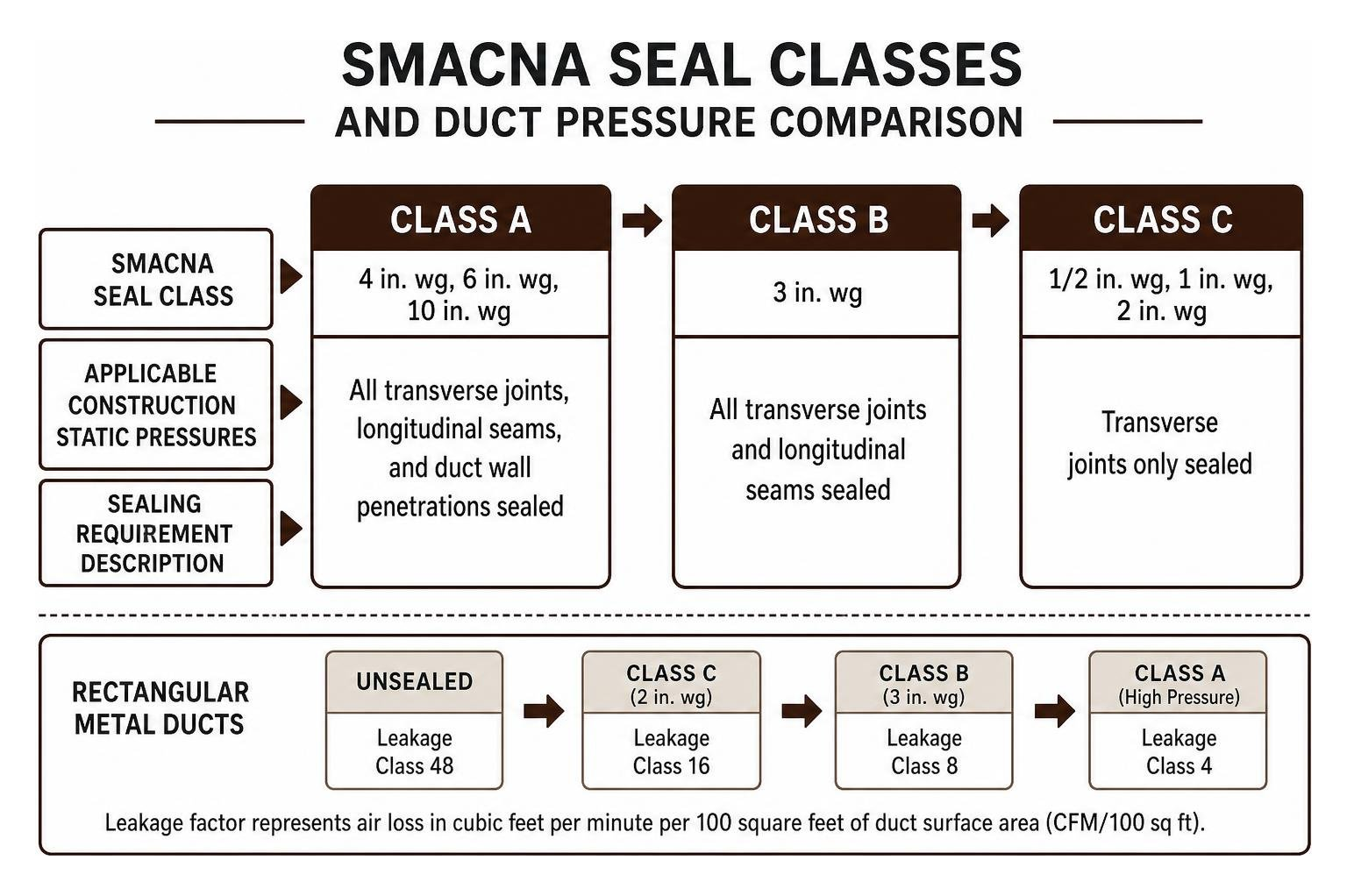
The Sheet Metal and Air Conditioning Contractors’ National Association (SMACNA) sets standardized seal classes based on operating static pressure. The HVAC Air Duct Leakage Test Manual guidelines outline three primary classifications:
| SMACNA Seal Class | Applicable Construction Static Pressures | Sealing Requirement Description |
|---|---|---|
| Class A | 4 in. wg, 6 in. wg, 10 in. wg | All transverse joints, longitudinal seams, and duct wall penetrations sealed |
| Class B | 3 in. wg | All transverse joints and longitudinal seams sealed |
| Class C | 1/2 in. wg, 1 in. wg, 2 in. wg | Transverse joints only sealed |
Understanding the importance of professional duct sealing helps homeowners recognize that matching the correct seal class to system static pressure stops air loss before it starts.
Leakage Class Determination by Duct Material
Engineers determine the leakage class of a system by testing duct sections under controlled pressure differentials. The resulting leakage factor represents air loss in cubic feet per minute per 100 square feet of duct surface area (CFM/100 sq ft). Different materials and geometries show distinct leakage characteristics:
- Rectangular metal ducts: Unsealed rectangular metal duct may follow Leakage Class 48. When constructed to 2 in. wg per SMACNA standards with Class C sealing, rectangular duct typically tests at Leakage Class 16. Rectangular duct with Class B sealing at 3 in. wg targets Leakage Class 8, while Class A sealing for high-pressure systems targets Leakage Class 4.
- Round spiral ducts: Round ductwork naturally seals tighter than rectangular shapes because it has fewer longitudinal seams. Constructed to 2 in. wg with Class C sealing, round duct tests at Leakage Class 8. At Class B sealing (3 in. wg), round duct achieves Leakage Class 4, and high-pressure Class A sealing reaches Leakage Class 2.
- Nonmetal flexible ducting: Unsealed flexible duct leakage averages an estimated Class 30. Properly sealed flexible duct connected with approved tensioning collars achieves an average of Class 12.
- Fibrous glass duct systems: Rigid fibrous glass board ducts follow Leakage Class 6 when operating at 2 in. wg or less.
The Core Process of a Duct Sealing Air Leakage Test
A formal duct test uses calibrated fan pressurization to measure total air loss. Technicians temporarily seal the entire duct network from the living space and connect a specialized diagnostic fan and digital manometer.
Following the ANSI/RESNET/ICC 380 airtightness standard, technicians pressurize the duct system to a positive test pressure of 25 Pascals (0.1 in. wg) relative to the surrounding space. The diagnostic tool measures the airflow volume required to maintain that exact pressure. We record this number as CFM25, which provides a repeatable benchmark of duct tightness.
Understanding how duct sealing works gives homeowners a clear look into how technicians identify structural weak points along the supply and return trunks.
Preparation and Calibration for a Duct Sealing Air Leakage Test
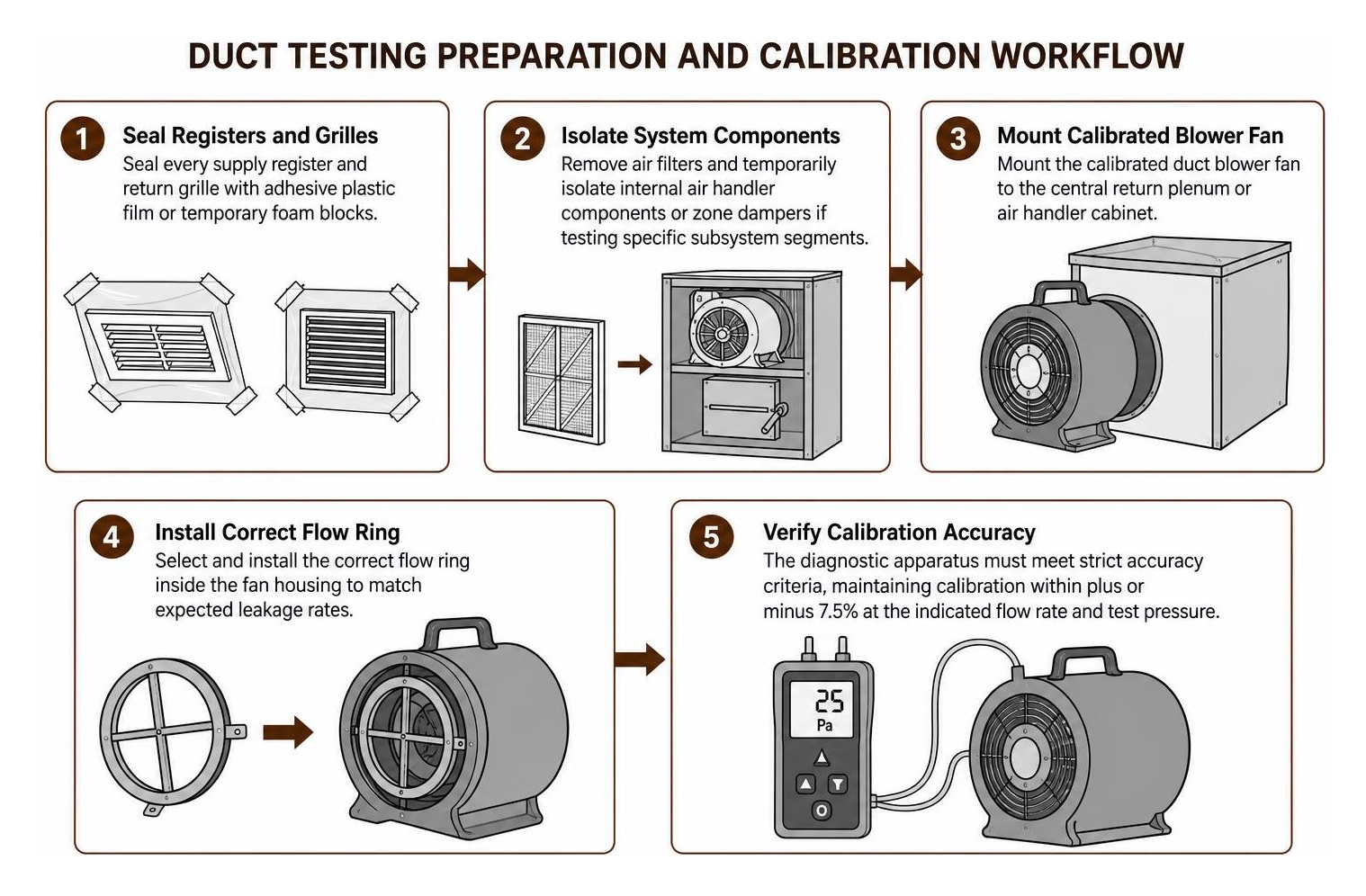
Accurate testing requires careful site preparation and tool calibration:
- Technicians seal every supply register and return grille with adhesive plastic film or temporary foam blocks.
- The technician removes air filters and temporarily isolates internal air handler components or zone dampers if testing specific subsystem segments.
- The technician mounts the calibrated duct blower fan to the central return plenum or air handler cabinet.
- The technician selects and installs the correct flow ring inside the fan housing to match expected leakage rates.
- The diagnostic apparatus must meet strict accuracy criteria, maintaining calibration within plus or minus 7.5% at the indicated flow rate and test pressure.
Quantitative Measurement and Smoke Leak Detection
Once the digital manometer confirms stable pressure at 25 Pascals, the test records the steady-state flow rate. The technician calculates the surface-area leakage factor F to evaluate compliance against engineering specifications.
When quantitative numbers reveal excessive leakage, technicians introduce non-toxic, theatrical smoke into the pressurized duct run. As the smoke moves through the trunks under positive pressure, plumes escape visibly through unsealed fittings, takeoffs, and plenum joints. This visual confirmation allows contractors to pinpoint tiny structural gaps without tearing down finished walls or ceilings.
Roles, Responsibilities, and Code Compliance in Duct Testing
HVAC designers, mechanical contractors, and third-party inspectors share clear responsibilities throughout system installation:
- Designers: Specify required SMACNA seal classes, target leakage limits, and operating static pressure ratings on construction drawings.
- Contractors: Fabricate, assemble, and seal all duct sections using approved materials, then conduct quality-control testing.
- Third-Party Verifiers: Energy raters test and certify installed systems to confirm compliance with energy codes and building programs.
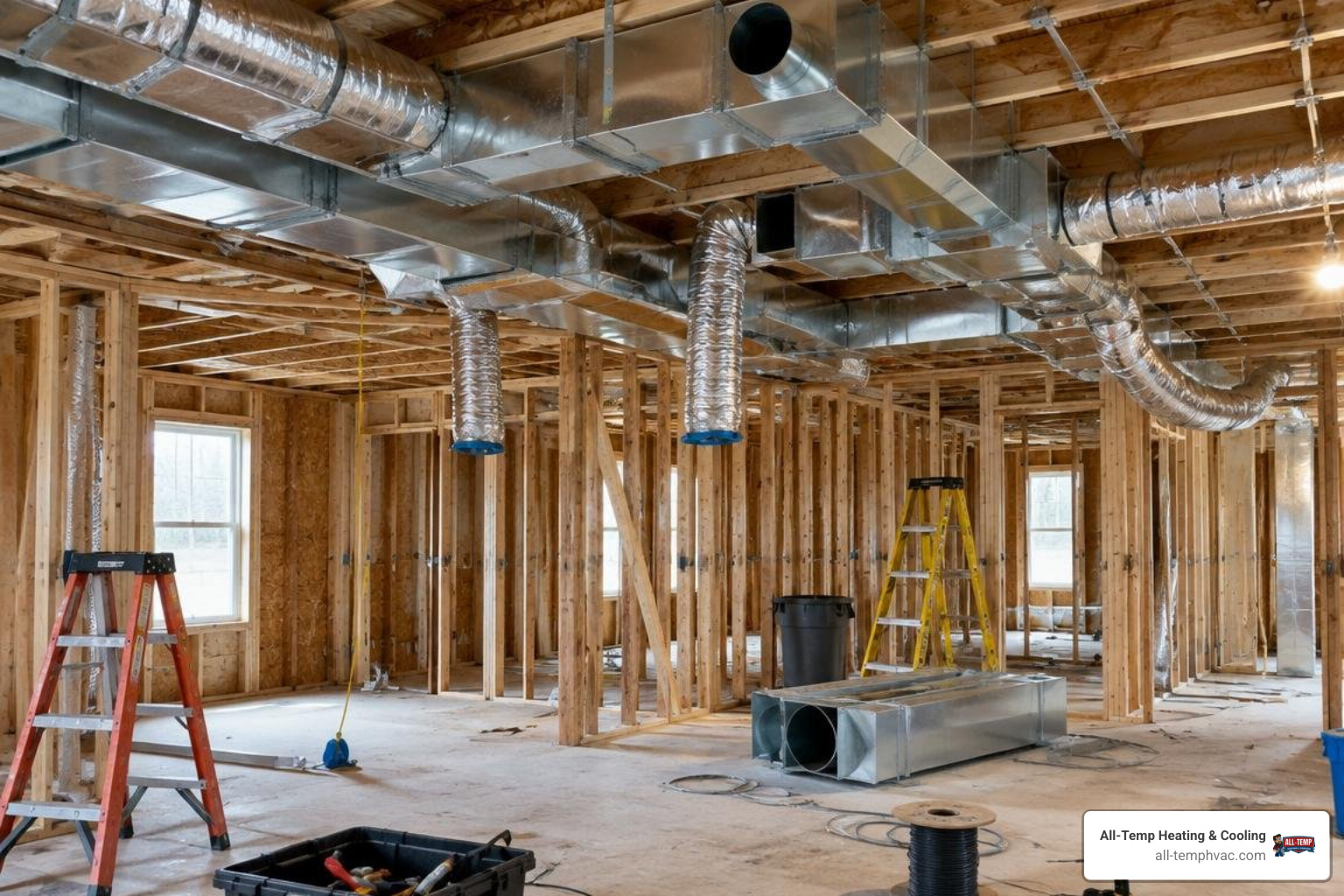
Testing takes place at two main milestones: rough-in and post-construction. Rough-in testing occurs after duct installation but before drywall installation. This timing gives technicians complete physical access to seal joints or fix dislodged branch runs. Post-construction testing occurs after trim-out to ensure final register boots and grilles seal properly to the interior drywall. Following standard total duct leakage testing protocols ensures every home achieves measurable energy efficiency improvements over its operational lifetime.
Distinguishing Total Duct Leakage from Leakage to the Outdoors
Modern building codes evaluate air loss based on where the escaped air travels:
- Ducts entirely inside conditioned space: Air leaking inside the thermal envelope remains within the heated or cooled area of the home. Building codes often permit up to 8.0 CFM25 per 100 sq ft of conditioned floor area for these systems.
- Ducts located in unconditioned spaces: Air escaping into attics, vented crawlspaces, or exterior wall cavities represents a direct thermal loss. Energy codes enforce a strict threshold of 4.0 CFM25 per 100 sq ft (or 3.0 CFM25 if tested at rough-in without the air handler installed).
Sealing Solutions and Remediating Tested Duct Leaks
When a duct test reveals leakage rates above code limits, our team applies targeted sealing methods to restore proper airtightness:
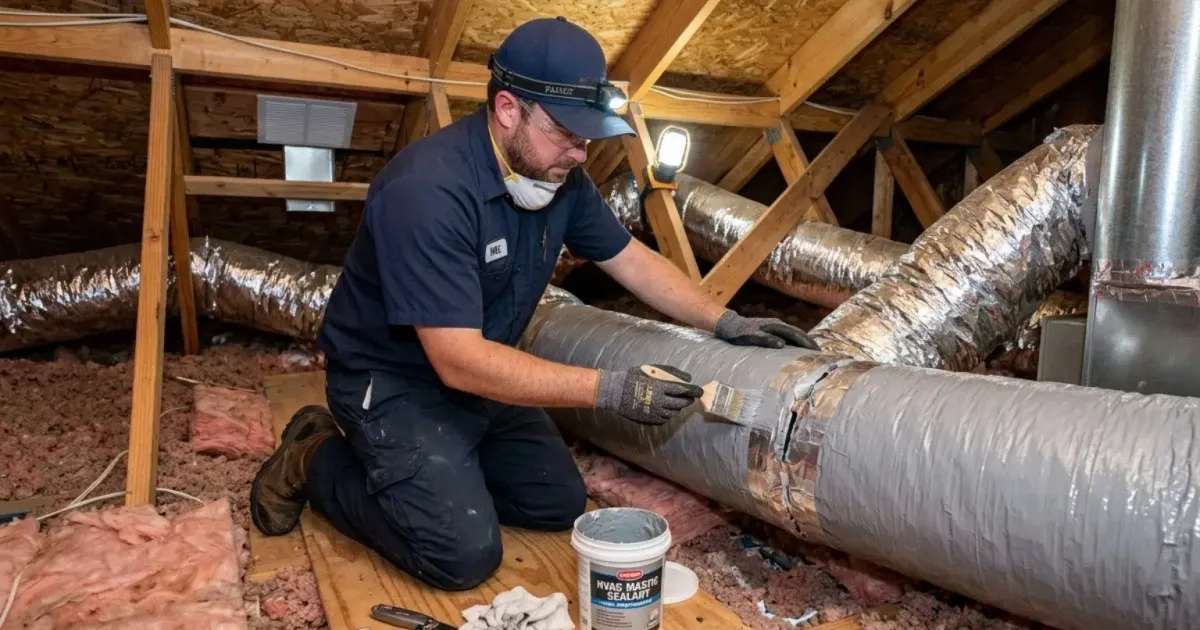
- Water-based mastic paste: Technicians brush thick, fiber-reinforced mastic over transverse joints, longitudinal seams, and collar takeoffs. Mastic stays flexible over decades of thermal expansion.
- Fiberglass mesh tape: Technicians embed fiberglass mesh into wet mastic across gaps wider than 1/4 inch to provide structural bridging strength.
- UL 181-listed foil tape: Technicians apply heat-resistant aluminum foil tape along smooth metallic transitions and access panels. Standard cloth duct tape degrades quickly and does not meet code requirements.
- Aerosol-based sealant: Technicians inject atomized sealant particles directly into pressurized ducts to seal inaccessible leaks from the inside out.
Using proven mastic duct sealing techniques forms a durable, airtight seal along sheet metal connections. For hidden or hard-to-reach duct sections, aeroseal aerosol duct sealing seals remote branch lines inside wall cavities.
Properly sealed ductwork also prevents dusty attic air and crawlspace moisture from entering the supply stream, directly protecting indoor air quality throughout the home.
Frequently Asked Questions About Duct Testing
When is a Duct Sealing Air Leakage Test Required by Building Codes?
Building codes require duct testing on all new residential construction projects where any portion of the ductwork extends outside the conditioned building envelope. Testing is also mandatory during major HVAC system replacements, substantial duct alterations exceeding 40 linear feet, and third-party green building verifications.
How Does Duct Leakage Affect Heat Pump and Air Conditioner Performance?
Leaky ducts cause static pressure imbalances that reduce total airflow volume across the evaporator coil or heat exchanger. This airflow loss forces compressors and heat pumps to run longer cycles, creates hot and cold spots in distant rooms, and increases wear on moving blower components.
What is Considered an Acceptable Duct Leakage Rate?
Modern building and energy codes consider duct systems compliant when total leakage measures below 4.0 CFM25 per 100 square feet of conditioned floor area, or under 4% of total air handler airflow. High-performance homes often target leakage rates below 2% of total supply volume.
Restoring HVAC Performance Through Professional Duct Testing and Sealing
Unsealed ductwork can silently waste up to 30% of your heating and cooling output before conditioned air ever reaches your living spaces. Scheduling a professional diagnostic inspection confirms your system delivers conditioned air where you need it most.
All-Temp Heating & Cooling delivers thorough duct testing, sealing, and whole-home HVAC solutions across Staunton, Harrisonburg, Waynesboro, Charlottesville, and surrounding Virginia communities. Our technicians use calibrated diagnostic tools to measure air leakage and restore balanced airflow throughout your property. Every service visit includes honest guidance, modern diagnostic methods, and our two-year labor warranty.
Contact our professional duct sealing technicians to schedule a comprehensive duct evaluation.