

What a Complete AC Tune-Up Checklist Actually Covers
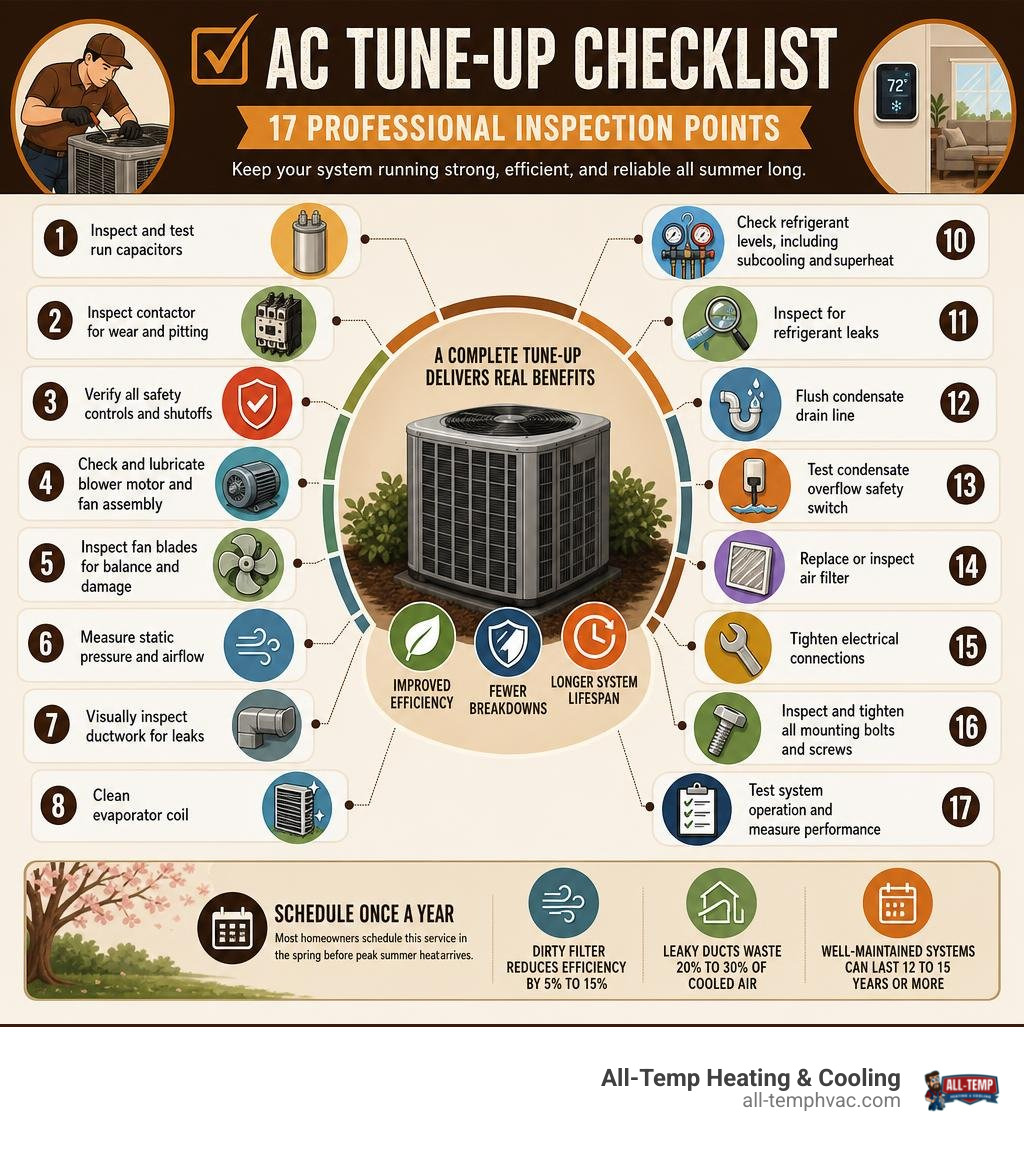
A thorough AC tune-up checklist covers 17 or more specific inspection points across your entire system, from electrical components to refrigerant levels and airflow. Here is a quick overview of what every professional visit should include:
The 17-Point AC Tune-Up Checklist:
- Thermostat calibration and settings check
- Tighten and inspect all electrical connections
- Test voltage and amperage on motors
- Inspect and test run capacitors
- Inspect contactor for wear and pitting
- Verify all safety controls and shutoffs
- Check and lubricate blower motor and fan assembly
- Inspect fan blades for balance and damage
- Measure static pressure and airflow
- Visually inspect ductwork for leaks
- Clean evaporator coil
- Clean condenser coil
- Check refrigerant levels, including subcooling and superheat
- Inspect for refrigerant leaks
- Flush condensate drain line
- Test condensate overflow safety switch
- Replace or inspect air filter
Most homeowners in Staunton, VA, and surrounding areas schedule this service once a year in the spring, before peak summer heat arrives.
Every spring, low-cost AC tune-up ads flood the market, leaving homeowners wondering whether the technician actually did anything during a brief 15-minute visit. A real tune-up takes 60 to 90 minutes and covers far more than a quick filter swap and a glance at the outdoor unit.
Skipping annual maintenance carries real consequences:
- A dirty filter alone can reduce your system’s efficiency by 5% to 15%
- Leaky ducts can waste 20% to 30% of your cooled air before it ever reaches your living spaces
- A neglected system often fails at the 8 to 10 year mark, while a well-maintained one can last 12 to 15 years or more
At All-Temp Heating & Cooling, our team has spent over 15 years servicing HVAC systems across the Shenandoah Valley. We know how a complete AC tune-up checklist separates systems that run strong for 15 years from ones that fail early. In this guide, we will walk you through every item a qualified technician should check, what you can do yourself, and how to spot a rushed job before it costs you.
The Ultimate Professional AC Tune-Up Checklist
When you schedule professional cooling maintenance, you are investing in the long-term reliability and efficiency of your system. A superficial inspection does not protect your equipment from unexpected summer breakdowns. To ensure you receive a thorough service, you should understand what a real preventative maintenance visit entails.
A comprehensive evaluation requires the technician to open both the indoor air handler and the outdoor condenser unit. This access allows them to inspect internal components hidden from view. If a technician only walks around your outdoor unit with a hose and leaves within twenty minutes, your system did not receive proper service.
Electrical and Control Inspections on the AC Tune-Up Checklist
The electrical system is the brain and nervous system of your air conditioner. During a professional visit, our technicians focus heavily on testing these components because electrical failures are the most common cause of sudden system shutdowns during hot weather.
First, the technician calibrates the thermostat. They verify that the temperature your thermostat reads actually matches the physical temperature in your living space. An uncalibrated thermostat can cause your system to run too long or cycle on and off too quickly, which places unnecessary stress on the compressor.
Next, the technician opens the electrical panel to inspect and tighten all connections. Because metals expand and contract as they heat and cool, electrical terminals can loosen over time. Loose connections lead to electrical arcing, damaged wiring, and potential control board failures.
The technician also measures the voltage and amperage on the blower motor and the outdoor fan motor. If a motor draws too much current, it indicates that the motor is overheating or reaching the end of its operational lifespan.
Testing the run capacitors is another critical step. Capacitors act like temporary batteries, providing the extra electrical surge needed to start the motors. If a capacitor measures 10% or more below its rated microfarad capacity, it is close to failing. Replacing a weak capacitor during a scheduled visit prevents a complete system failure on a hot afternoon.
Finally, the technician inspects the contactor for pitting or burn marks and tests all safety controls. During a professional AC maintenance appointment, All-Temp Heating & Cooling follows these steps to help protect your electrical system and reduce the risk of unexpected cooling failures.
Mechanical and Airflow Checks on the AC Tune-Up Checklist
Proper airflow is essential for the heat transfer process that cools your home. If air cannot move freely through your system, your air conditioner will run longer, consume more electricity, and fail to keep you comfortable.
The technician inspects the blower motor and the blower wheel. Even a thin layer of dust on a blower wheel blade acts like a weight, throwing the fan out of balance. This imbalance causes vibrations that can crack refrigerant lines, damage motor bearings, and create loud squealing or grinding noises.
We also inspect the fan blades on the outdoor condenser unit to ensure they are balanced and free of cracks. A damaged fan blade can shatter during operation, causing catastrophic damage to the surrounding coil.
To assess the overall health of your air distribution system, the technician measures the static pressure. Think of static pressure as the blood pressure of your ductwork. High static pressure means your system is working too hard to push air through the vents, which reduces efficiency by up to 15 percent.
Additionally, the technician performs a visual inspection of the accessible ductwork. Leaky ducts are a major source of energy waste, often losing 20% to 30% of your conditioned air to unconditioned spaces like your attic or crawlspace. Routine HVAC maintenance helps preserve proper airflow, support cleaner indoor air, and keep utility costs under control.
Refrigerant and Coil Maintenance
Your air conditioner does not actually create cold air; it absorbs heat from inside your home and dumps it outside. This process relies on clean coils and precise refrigerant levels.
The technician inspects and cleans the indoor evaporator coil and the outdoor condenser coil. When dust, dirt, or pollen coats these coils, it acts as an insulating blanket. This insulation prevents the refrigerant from absorbing or releasing heat efficiently, forcing the compressor to run longer and hot air to blow from your vents.
Next, the technician measures the refrigerant levels using digital gauges. These digital tools allow for precise measurements of subcooling and superheat, which are necessary to determine if the system has the exact charge specified by the manufacturer. Because an AC is a sealed system, low refrigerant always indicates a leak. If levels are low, the technician must locate and repair the leak rather than simply adding more refrigerant.
Finally, the technician addresses the condensate drain system. As your AC cools the air, it also removes moisture. This water collects in a pan and flows out through a drain line. The technician flushes this line to clear away algae and dirt that can cause blockages. They also test the condensate overflow safety switch, which automatically shuts down the system if the drain line clogs, preventing expensive water damage to your ceilings and floors.
For older systems, tune-ups can also reveal when recurring issues point to a bigger cooling problem. If your equipment is struggling to keep up even after maintenance, our air conditioning services team can inspect the full system and recommend the right next step for your Staunton, VA, home.
DIY Maintenance Tasks to Handle Before Your Pro Arrives
While professional technicians must handle electrical testing and refrigerant measurements, homeowners can perform several basic maintenance tasks. Taking care of these simple chores before your scheduled appointment helps your technician focus on the highly technical aspects of the tune-up.
First, inspect your air filter. A dirty, clogged filter restricts airflow, increases your energy costs, and can cause your evaporator coil to freeze. You should check your filter every 30 days and replace it every 60 to 90 days, or more frequently if you have pets or live in a dusty area. Replacing a dirty filter with a clean one is the easiest way to cut your energy use by 5% to 15%.
Second, clear the area around your outdoor condenser unit. Your outdoor unit needs room to breathe so it can release heat. Maintain at least two feet of clear space around the unit by trimming back weeds, bushes, and low-hanging branches. Clear away any grass clippings, leaves, or pine needles that have accumulated against the metal fins.
Third, dust off your indoor supply and return registers. Ensure that furniture, curtains, or rugs are not blocking any vents. Restricting airflow at the registers forces your system to work harder, which can lead to early equipment failure.
Finally, check the batteries in your thermostat. If your thermostat uses batteries, replace them annually to prevent your cooling system from shutting down unexpectedly due to a loss of control power.
Seasonal upkeep works best when homeowners and technicians both do their part. Following practical summer AC maintenance tips between visits can help your system run smoothly and keep your home comfortable all summer long.
Timing, Costs, and the Real Value of Preventative Care
Timing your maintenance properly can save you money and prevent scheduling delays. Most homeowners schedule their cooling service in the early spring, from late March through early May. During this transitional season, HVAC companies are not yet flooded with emergency repair calls, allowing you to secure a convenient appointment slot.
Waiting until the first major heatwave in July often means facing longer wait times and potential delays if your system needs a replacement part.
| Maintenance Window | Pros | Cons |
|---|---|---|
| Spring (March – May) | Flexible scheduling, lower risk of early summer breakdown, technician has more time for a deep inspection. | Easy to forget if the weather is still mild. |
| Summer (June – August) | Addresses immediate cooling issues. | High risk of scheduling delays, technician may be rushed due to emergency call volume. |
Investing in preventative care pays off in several ways. Regular maintenance keeps your system running at peak energy efficiency, which directly lowers your monthly utility bills. It also protects your indoor air quality. Because Americans spend roughly 90% of their time indoors, and indoor pollutants can be 2 to 5 times higher than outdoor levels, keeping your system clean is vital for your health.
Scheduling service early also gives you time to address small issues before peak cooling season. The full benefits of spring AC maintenance include steadier comfort, better efficiency, longer equipment life, and fewer surprise repair calls when temperatures rise.
Frequently Asked Questions About AC Maintenance
How long does a professional AC tune-up take?
A high-quality, professional AC tune-up typically takes between 60 and 90 minutes. This time allows the technician to perform a thorough inspection, clean the coils, flush the drain line, and test all electrical and mechanical components. If a technician finishes the entire job in 15 or 20 minutes, they have skipped critical safety and efficiency checks.
What is the difference between an AC tune-up and an HVAC tune-up?
An AC tune-up focuses specifically on your cooling system components, such as the condenser coil, evaporator coil, and refrigerant levels. Technicians typically perform this service in the spring.
An HVAC tune-up is a broader term that can include both heating and cooling components. For homeowners with a heat pump, which handles both heating and cooling, we recommend a full system tune-up twice a year: once in the spring for the cooling cycle and once in the fall for the heating cycle.
What are the red flags of a substandard tune-up?
The most common red flag of a substandard tune-up is rushed service that lasts under 30 minutes. Another red flag is a technician who uses outdated analog gauges rather than digital tools, which are necessary to measure subcooling and superheat accurately.
Additionally, be wary of any technician who does not provide a written report of their findings, or who suggests adding refrigerant to your system without performing a leak search to find out why the level was low in the first place.
Keep Your Staunton Home Cool with Professional Service
At All-Temp Heating & Cooling, we provide honest, high-quality air conditioning and indoor air quality services for homeowners and small businesses in Staunton, Harrisonburg, and Waynesboro. We believe in doing the job right the first time, which is why we back our work with a two-year labor warranty and use the latest diagnostic technology to keep your system running efficiently.
Whether you live in Stuarts Draft, Bridgewater, Elkton, or anywhere else in Augusta County, our team is ready to help you prepare your home for the summer heat. We do not believe in high-pressure sales tactics or rushed, superficial inspections. When you schedule a tune-up with us, you can trust that our technicians will hit every point on the checklist to keep your system reliable and efficient.
Do not wait for the summer heat to catch you by surprise. Contact our professional AC maintenance technicians today and enjoy peace of mind all summer long.